
Earlobes are small, but a torn, split or stretched lobe has an outsized effect on how people feel about their appearance. The damage usually comes from years of heavy earrings, a sudden pull, ear gauges someone no longer wants, or simply the thinning that comes with age. Earlobe repair is a minor surgical procedure that rebuilds the lobe’s outline. Once a lobe has split, it is what a plastic surgeon uses to close it.
Can a torn earlobe heal on its own?
No. Once the tissue has split, or stretched significantly, the edges cannot knit back together the way a cut in the skin would, because there is nothing holding them against each other. The piercing channel has its own healed lining, so the body treats it as finished rather than as a wound to close.
Creams, fillers and at-home remedies do not repair structural damage either. Closing a split lobe is a surgical job.
Can a stretched piercing hole shrink back?
Sometimes, a little, and only early. Mild stretching may improve if heavy earrings come out soon enough and the tissue is given a rest. Once the hole has stretched significantly, the skin does not fully tighten on its own, and that is especially true when age-related collagen loss is part of the picture.
Prevention works. Reversal, past a certain point, does not.
Why earlobes tear, split or stretch
Earlobe damage rarely happens overnight. It usually builds over months or years of repeated tension on delicate tissue, and the lobe can look normal long after the structural change has started. The common causes:
- Heavy earrings worn over years, which gradually pull the piercing channel longer
- A sudden tug, from an earring caught on clothing, a towel, or pulled by a child
- Piercings placed too close to the edge of the lobe, leaving little tissue to carry the weight
- Ear gauges or large plugs, which stretch tissue deliberately and often permanently
- Aging, as skin loses elasticity and the lobe thins
Five early signs of earlobe damage
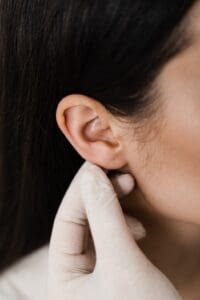
The useful thing about earlobe damage is that it announces itself before it becomes a tear. Surgeons who repair earlobes often meet patients who wish they had noticed sooner.
1. Earrings sit lower than they used to
Often the first sign. Compared with older photographs, the earring no longer sits centered in the lobe and has drifted toward the bottom edge. The piercing channel has begun to elongate. There is usually no pain at this stage, which is why it gets missed.
2. The hole looks more like a slit than a circle
A healthy piercing is a small round opening. As tissue stretches, that shape turns oval, then vertical, then slit-like. It is a sign the surrounding tissue is under constant stress and thinning.
3. Earrings feel less secure
Studs droop forward, hoops sit unevenly, jewelry moves more than it did. That is usually structural weakening rather than a problem with the earrings.
4. One earlobe looks different from the other
Damage is often not symmetrical. Sleeping position, hand dominance, heavier jewelry worn on one side or an old pull can all stretch one lobe more than the other. A small asymmetry tends to become more noticeable over time.
5. The bottom of the lobe looks thin
This is the one not to ignore. As the hole travels downward, less tissue remains between it and the edge of the lobe. When that bridge is very thin, the risk of a complete split rises sharply. It behaves like worn fabric: once enough material is gone, tearing takes very little.
Richmond, VA
Not sure whether an earlobe needs repairing yet?
Dr. Matthew G. Stanwix sees earlobe repair patients at Stanwix Plastic Surgery in Richmond.
When stretching turns into a torn earlobe
There is not always a dramatic moment. Sometimes the piercing channel simply travels until it nearly reaches the edge of the lobe and the remaining bridge gives way. Other times a single sudden pull splits it outright. Either way, once the lobe is through, repair means surgery.
Waiting usually makes repair harder
Many people wait because the damage does not look bad enough yet. The difficulty is that a larger tear generally means more tissue has been lost, more reshaping is needed, and the two lobes are further apart in size and shape. Addressing it earlier preserves more natural tissue and keeps the correction simpler.
How earlobe repair surgery works

Earlobe repair is a minor surgical procedure, usually carried out in the office under local anesthetic. The aim is to rebuild the lobe’s natural outline while leaving as little visible trace of the repair as possible.
- The area is numbed.
- The thinned or scarred edges of the stretched or split tissue are removed, since scarred edges will not heal to each other.
- The lobe is reconstructed to restore its contour and, where possible, to match the other side.
- Fine sutures close the repair.
Repair can correct partial tears, fully split lobes, enlarged piercing holes and elongated tissue from gauges. Whether one or both ears need work affects what the procedure involves.
What separates a good repair from a closure
An earlobe repair is at its best when nobody can tell it happened. That comes down to three things:
- Shape and proportion, so both lobes match naturally rather than one looking shortened
- Scar placement, sited in natural folds and contours where the eye does not settle
- Tissue balance, preserving enough volume that the repaired lobe looks full rather than flattened
These are the details that separate a refined repair from a simple closure, and they are the reason this small procedure rewards an experienced surgeon. Dr. Stanwix’s before-and-after gallery shows how his results look across procedures. Dr. Stanwix is certified by the American Board of Plastic Surgery and works across earlobe repair, scar revision, lesion and cyst removal, all of which turn on precise closure.
Wondering whether a stretched lobe still has enough tissue to repair well? Call Stanwix Plastic Surgery on (804) 724-7244.
What recovery involves
Recovery from earlobe repair is straightforward, but the specifics belong to your surgeon rather than to an article: how long sutures stay in, when earrings can go back in, and when a lobe can safely be re-pierced all depend on how the lobe was repaired and how it heals. Expect to be given a timeline at your follow-up rather than a fixed one in advance.
What holds generally:
- The area is kept clean and dry.
- Earrings and pressure on the lobe are avoided until the repair is fully healed.
- Re-piercing waits for the surgeon’s go-ahead, and is usually placed in a stronger position with better tissue support than the original.
- Sun protection or scar care may be recommended while the scar matures.
Scars continue to mature for months after surgery, and your surgeon will advise on scar care. If you’re thinking about a scar you already have, how modern scar revision works covers the same principles on a larger scale.
How to protect earlobes from further damage
If the early signs are there, small changes reduce the load on tissue that is already vulnerable:
- Wear lighter earrings, and keep heavy statement pieces for occasions
- Take jewelry out overnight
- Be careful with clothing, towels and anything that can catch
- Give a sore or reddened lobe a rest rather than working through it
Who earlobe repair suits
Earlobe repair is usually considered for torn, split or stretched lobes, enlarged piercing holes, and scarring left by past piercings or gauges. Whether it suits you depends on how much tissue remains, the position of the piercing and your own health, which is what a consultation is for. Your surgeon will assess the lobe and tell you what is realistic before anything is booked.
Frequently asked questions
Can a split earlobe heal itself?
No. A fully split lobe has two healed edges that won’t rejoin on their own. Surgical repair removes those edges so the tissue can heal together.
Will I be able to wear earrings again?
Once the repair has healed and the surgeon agrees the lobe is ready, re-piercing is usually possible. The new piercing is positioned to sit better and carry weight more safely than the old one.
Does earlobe repair hurt?
The procedure is carried out under local anesthetic, so the lobe is numb during it. How much soreness follows varies from person to person, and your surgeon will talk you through what to expect and how to manage it.
Can both ears be done at once?
Whether both lobes are repaired in the same visit is something your surgeon decides with you, based on how each side is damaged.
What if only the piercing hole is stretched, not torn?
That’s still repairable, and more healthy tissue usually remains to work with, which is why earlier is simpler.
A stretched or split earlobe is a small problem that tends to get slowly worse, and it is one of the more straightforward things a plastic surgeon corrects. If the piercing is drifting downward or one lobe no longer matches the other, it’s worth having someone look at it while there is still plenty of healthy tissue to work with.
Earlobe repair in Richmond, VA
Dr. Matthew G. Stanwix is certified by the American Board of Plastic Surgery.
Call (804) 724-7244
Earlobe Repair & Scar Surgery
Stanwix Plastic Surgery
12320 West Broad Street, Suite 205, Richmond, VA 23233
Open Monday to Friday, 8:30am to 5pm
Serving Richmond and Henrico County, VA